Stage Your Next Listing Without the Price Tag
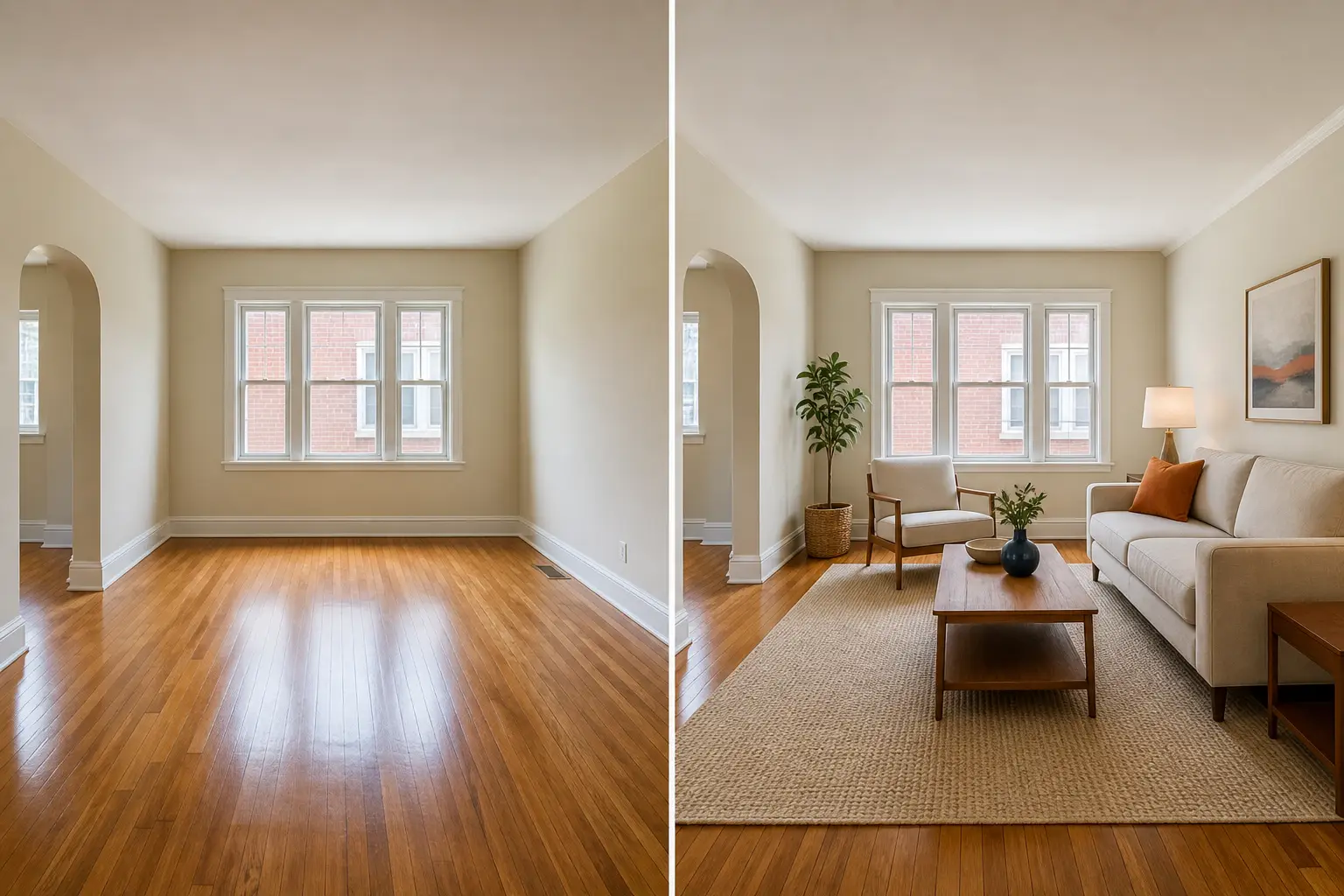
An empty house photographs like exactly what it is: empty. Buyers scrolling through listings on their phone see a bare living room and move on before they picture themselves in it. You know the room has good bones. The photo doesn’t show that.
Physical staging fixes this, and it works. It also costs $1,500 to $5,000 for a handful of rooms, more for a larger home, and it takes time you don’t have between a listing going live and the first open house. Movers have to be scheduled. Furniture has to be sourced and delivered. None of that happens overnight.
AI virtual staging solves the same problem differently. You send a photo of the empty room, and within a day or two you get back a photorealistic version with furniture, rugs, and art digitally placed in it. Most services charge somewhere between $3 and $15 per photo. Stage ten rooms across a few listings and you’re looking at well under a hundred dollars instead of several thousand.
The style options are part of what makes it useful. The same empty bedroom can come back staged as modern minimalist, coastal, farmhouse, or warm traditional, and you pick whichever one fits the buyer pool for that neighborhood. A downtown loft and a lake house don’t need the same furniture, even though both started as empty rooms waiting for the right photo.
Why staged listings perform better
You will find dramatic numbers about virtual staging on the internet. Most of them trace back to a vendor, or to an unnamed "study" that nobody can produce. Be careful repeating those to a seller, because sooner or later someone asks where they came from.
Here is a number you can stand behind. In NAR’s 2025 Profile of Home Staging, 83% of buyers’ agents said staging made it easier for a buyer to envision the property as their future home. Twenty-nine percent of sellers’ agents reported staging produced a 1% to 10% increase in the dollar value offered. Thirty percent saw a slight decrease in time on market and another 19% saw a significant one.
Those figures cover staging generally rather than virtual staging specifically, which is worth saying out loud. But the mechanism is the same one, and it is the mechanism that matters: staging changes whether a buyer can picture living there.
The living room is where to start. Buyers’ agents ranked it the most important room to stage at 37%, ahead of the primary bedroom at 34% and the kitchen at 23%. If you are staging one room on a budget, stage that one.
The staging didn’t change the house. It changed whether a buyer stopped scrolling long enough to book a showing. That’s the entire job of a listing photo, and it’s worth treating it like one.
What virtual staging doesn’t replace
A buyer still walks through the actual empty rooms at the showing. If the staged photos created an expectation the house can’t meet in person, you’ve cost yourself a showing instead of earning one. Use virtual staging to help buyers see possibility in the space, not to paper over a layout problem or a room that’s smaller than it looks in the photo.
Disclosure isn’t optional, and if you list through Canopy MLS the rule is more specific than most agents realize.
Canopy MLS Rules and Regulations § 1.18.1 permits AI-enhanced and virtually staged images, including adding or replacing personal property like furniture and artwork. It attaches three conditions.
The disclosure goes on the image. This is the part agents get wrong most often, usually with good intentions. Canopy’s rule states that "Disclosure provided ONLY in captions, agent remarks, or supplemental text is NOT acceptable." Putting a note in the remarks feels like disclosing. Under the rule, it is not. The disclosure has to appear on the image itself or within the virtual tour.
The original has to be available. An unstaged image of the same room must appear immediately before or after the edited image, or be easily accessible alongside the tour.
Some edits are off the table entirely. Modifying photos, renderings, or virtual tours "to include visual elements not within a property owner’s control, or that are not physically possible, is strictly prohibited." That is the line between adding a sofa to an empty room and inventing a fireplace, removing a structural feature, or replacing the view outside a window. Movable personal property is fine. Changes that imply alterations to the real property are not.
Canopy processes unauthorized listing content violations as Category II violations under § 8.4.2. The rule cites NAR’s Article 12 and Standard of Practice 12-10 directly, which is a useful thing to know: the MLS rule and the Code of Ethics are not two separate compliance systems. They are the same duty of a true picture, written down in two places.
Outside North Carolina, this is moving into statute. California’s AB 723 took effect January 1, 2026 and requires a conspicuous disclosure near any digitally altered listing image plus a publicly accessible link, URL, or QR code to the original. Routine adjustments like brightness, contrast, cropping, and straightening are not covered; adding, removing, or changing furniture, paint, landscaping, or views is. What gives that law teeth is where it sits: inside the real estate licensing law, where a willful violation can be prosecuted as a misdemeanor. Wisconsin’s Act 69 follows on January 1, 2027. New York has a bill pending and Department of State guidance, not a statute. Texas relies on existing TREC advertising rules.
North Carolina has no comparable statute today. The MLS rule is where this lives here, and MLS rules are usually where it starts.
If you want a simple system for getting every listing market-ready without burning a weekend on it, that’s the kind of workflow we build in AI for Realtors. Or book a free call and we’ll talk through what’s slowing your next listing down.